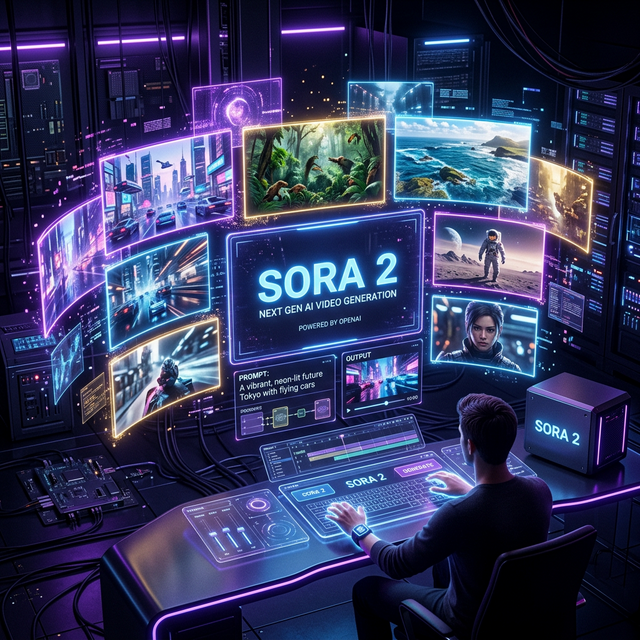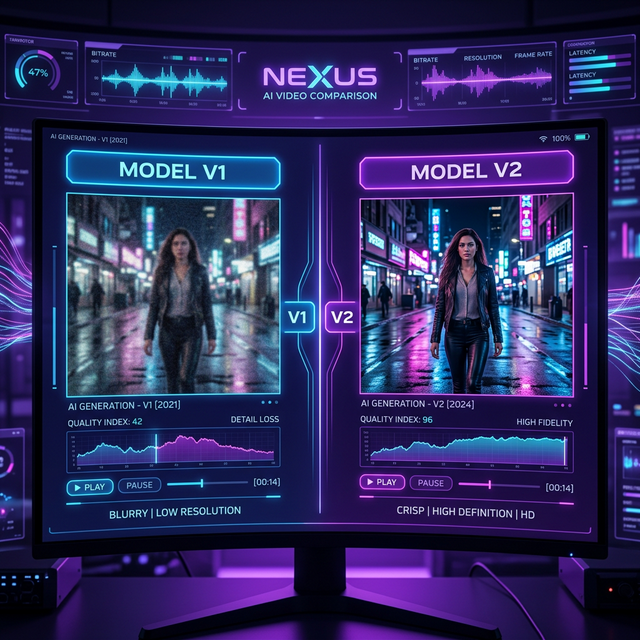
For those interested in the technical foundations, Sora 2 represents a significant evolution in the diffusion transformer architecture. Let's break down what makes it work.
Spacetime Latent Patches
Sora 2 processes video as a sequence of spacetime patches — 3D chunks of visual data that capture both spatial content and temporal movement. This is fundamentally different from processing individual frames.
The DiT Backbone
The Diffusion Transformer (DiT) architecture replaces the U-Net commonly used in image diffusion models. DiT uses standard transformer blocks with adaptive layer normalization, enabling better scaling and more efficient training.
Flow Matching
Sora 2 uses flow matching instead of traditional DDPM-style diffusion. This provides straighter sampling trajectories, requiring fewer denoising steps and resulting in faster generation.
Training Data
While OpenAI hasn't disclosed specific training data details, the model demonstrates understanding of: - Physical world dynamics - Camera behavior and cinematography - Human anatomy and motion - Material properties and lighting
Key Improvements Over Sora 1
- 1Temporal coherence — Better consistency over longer sequences
- 2Resolution scaling — More efficient 4K generation
- 3Multi-modal output — Joint video-audio generation
- 4Controllability — Better prompt adherence through improved conditioning
Research Implications
Sora 2 suggests that transformer-based architectures can effectively model complex temporal dynamics. This has implications beyond video generation, potentially impacting robotics, simulation, and scientific modeling.
For practical use, the architecture enables the reliable generation of professional-quality video. Save your experiments with Soradown.